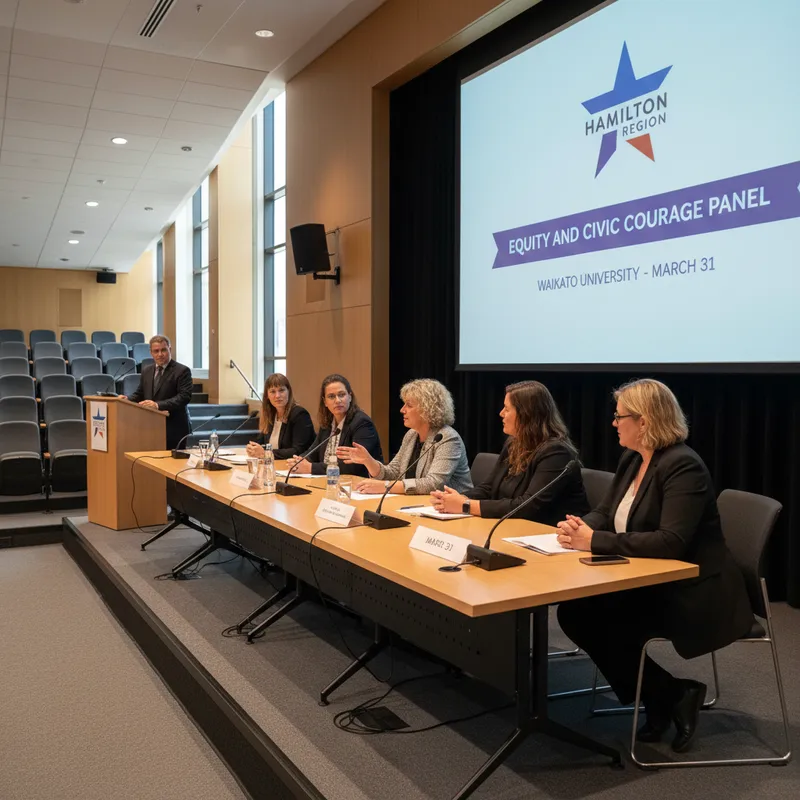
A free public panel in Hamilton will put gender and race on the same stage.
The discussion, titled “Equity, Identity & Civic Courage in Aotearoa”, is set for Tuesday, March 31, from 5.30pm to 7pm at the Gallagher Academy of Performing Arts at the University of Waikato.
The event is part of the “Whiria Te Tangata: Weaving Communities Together” seminar series, co-hosted by the Waikato Intercultural Fund of Momentum Waikato Community Foundation and the University of Waikato’s School of Law, Politics, and Philosophy.
Organisers are framing the evening as a way to connect International Women’s Day on March 8 with International Race Relations Day on March 21, 2026.
When and where is the equity, identity & civic courage panel in hamilton?
Doors open at 5pm, with an opening karakia and welcome at 5.30pm.
Introductions begin at 5.35pm, then panellists speak for about five minutes each from 5.45pm. Audience questions follow from 6.10pm, before concluding comments at 6.40pm and closing karakia at 6.50pm.
It is not a catered event. Seats are free but need to be reserved through the Humanitix ticket page.
Donations are optional. The listing invites people to donate to the Waikato Intercultural Fund via momentumwaikato.nz/waikatointerculturalfund.
Who is on the panel: margaret wilson, kemi fayomi, jumana fouda and molly āperira huggan
The line-up spans law, community organising, engineering, and Māori-led climate action.
Margaret Wilson is a lawyer, academic and former politician, and currently chair of Momentum Waikato. She was the founding dean of the University of Waikato Law School in the 1990s and served as Attorney-General and Speaker of the House in the 2000s.
The event profile links Wilson’s work to “constitutional development, labour rights, and justice reform”, and to ministerial portfolios including Labour, Commerce and Treaty of Waitangi Negotiations.
Kemi Fayomi, chair of Afro Connect NZ, was born and raised in Nigeria and now works as an engineer in New Zealand’s food industry. The event listing says she is focused on “empowering the African community” and “creating thriving community spaces”.
Jumana Fouda is described as a “young Muslim advocate and community organiser” working across racial equity, gender justice and youth leadership. The listing says her work includes issues such as food insecurity, inequitable access to opportunity and representation.
Molly Āperira Huggan (Te Aitanga-a-Māhaki, Rongowhakaata, Ngāi Tāmanuhiri) is an activist with Māori-led climate-action rōpū Ngā Haumi and has completed a degree in Māori and Indigenous Studies and History. The listing says she is now conceptualising her role in advocating for constitutional and social justice for communities impacted by racism, environmental injustice and neo-colonial capitalism.
“Combining International Women’s Day and Race Relations Day allows us to explore the intersection of gender, ethnicity, and civic identity in a way that reflects the lived realities of our communities.”
That intersection is already part of local civic life, including at education providers. The university’s own programme changes have drawn interest, including its 2026 paper list for banking and finance and a separate outline of fintech papers for 2026.
The night is also positioned as a public conversation rather than an academic lecture. A live discussion format and audience Q&A are built into the run sheet.
What topics will the panel cover: gender equity, hate and leadership
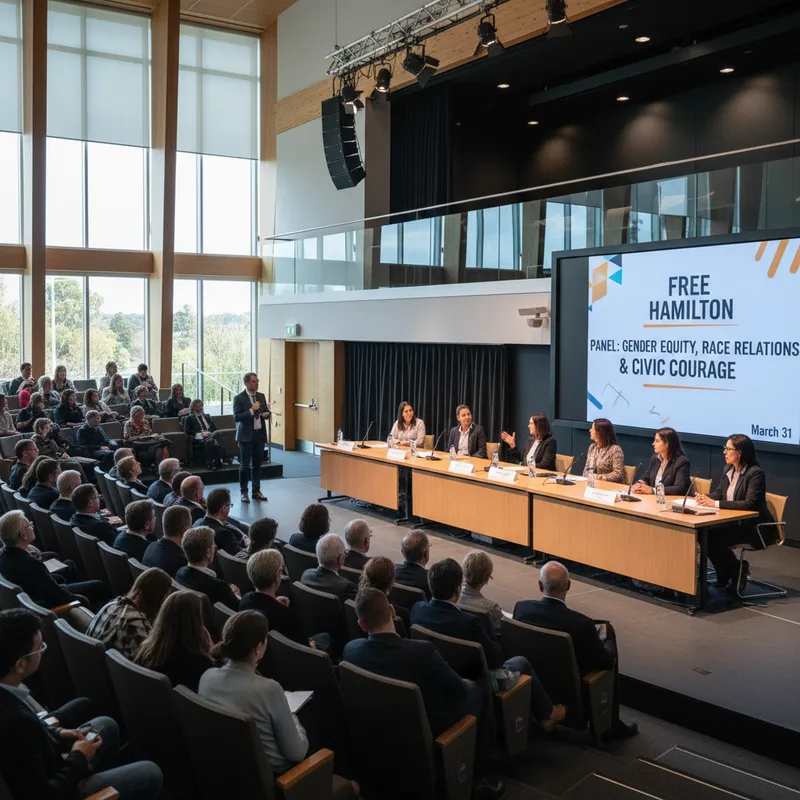
The organisers have laid out three topic areas, each with a set of prompt questions for the panellists and the room.
Under “Gender Equity and Intersectionality”, the prompts ask what progress Aotearoa has made, where the gaps remain, and how equity can include “mana Māori, Pacific, migrant, refugee, and ethnic women”.
Under “Responding to Hate and Division”, the prompts ask what tools communities need to counter racism, misogyny, and disinformation. They also ask how people build resilience and solidarity across difference, and how communities move “from symbolic inclusion to structural change”.
“What tools do communities need to counter racism, misogyny, and disinformation?”
Under “Leadership and Representation”, the prompts ask what inclusive leadership looks like in 2026 and beyond. They also ask what constitutional reforms could protect women and minority rights, and what civic courage means in today’s Aotearoa.
Those questions land in a year where public debate has also centred on social cohesion, online harms and democratic resilience. The Department of Internal Affairs outlines its work to counter disinformation and misinformation, including guidance on how false content spreads, at dia.govt.nz/Disinformation.
Organisers have not published a list of facilitator questions beyond the topic prompts. The agenda sets aside 30 minutes for questions from the facilitator and then the floor.
Why this event is part of the whiria te tangata seminar series
This is the third event in the “Whiria Te Tangata: Weaving Communities Together” series run by the Waikato Intercultural Fund.
The series previously hosted Nanaia Mahuta at the University of Waikato in July 2025 and economist Shamubeel Eaqub at Wintec in October 2025, according to the event listing.
By anchoring the March 31 event at the university’s performing arts venue, organisers are signalling they want the conversation to be public-facing and accessible, not just for students or staff.
Hamilton has no shortage of community calendars. Other major crowd events include the annual balloon festival, with Balloons over Waikato returning to the city in early March.
The organisers’ choice to explicitly link Women’s Day and Race Relations Day also makes the panel broader than a single-issue forum. It invites people who care about workplace equality, migrant settlement, youth voice, and constitutional settings to share the same room.
People outside the Waikato are also holding similar public conversations about how communities live with difference. A recent Canadian report on a family calling for city action after a coyote attack shows how local issues can escalate into city-wide debates about safety and responsibility, in Toronto family demands city action.
How to get tickets and support the waikato intercultural fund
Tickets are free and distributed through Humanitix, with a “Get Tickets” link on the event page.
Humanitix says it dedicates 100 per cent of profits from booking fees to charity. The listing encourages donations to the Waikato Intercultural Fund either during the ticket process or through the fund’s website.
For people deciding whether to go, the main practical details are the start time, the non-catered format, and the Q&A focus.
Doors open at 5pm on Tuesday, March 31, at the Gallagher Academy of Performing Arts, with the opening karakia scheduled for 5.30pm.
“FREE EVENT - please reserve your seat/s by clicking 'Get Tickets'.”
Combining International Women’s Day and Race Relations Day allows us to explore the intersection of gender, ethnicity, and civic identity in a way that reflects the lived realities of our communities.
The panel begins at 5.45pm, and the agenda allocates time for questions from 6.10pm before closing at 6.50pm.