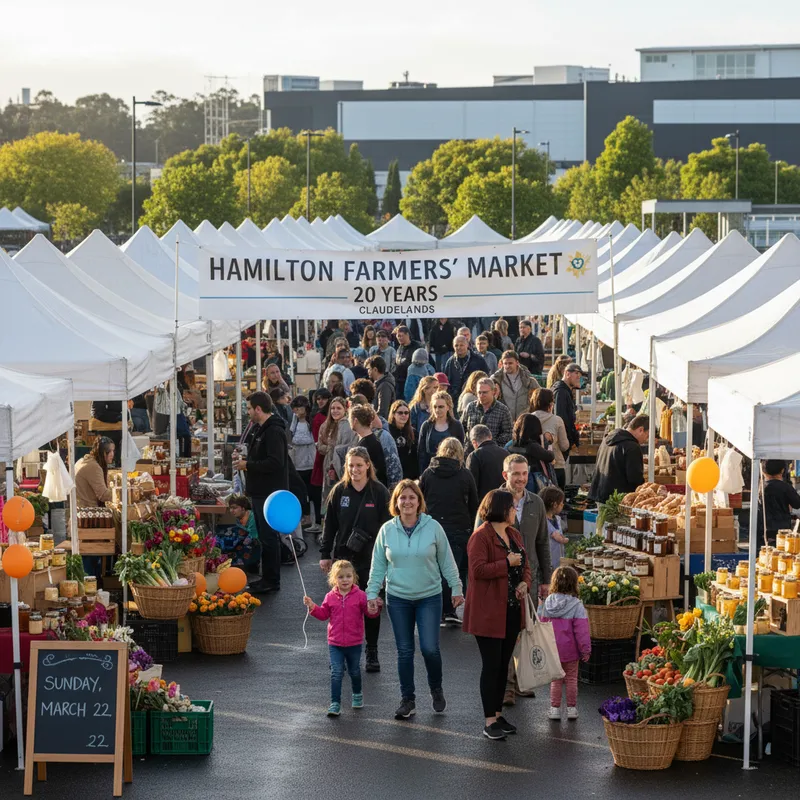
Hamilton Farmers’ Market will turn 20 this Sunday, with cake, photos and prize draws.
The weekly market now pulls about 2000 people through The Barn at Claudelands Events Centre each Sunday morning.
What began in 2006 as a fortnightly gathering of 15 stalls in a Wintec carpark has grown into an award-winning fixture with up to 50 stallholders. Market manager Jen Wilkinson says the milestone matters because the market has kept its core purpose, putting local growers and makers face to face with Hamilton shoppers.
“It’s a market family really, an established community,” Wilkinson said.
Wilkinson joined the market team in 2021 and has watched long-time customers keep turning up, often alongside their children and grandchildren. She says the stallholder mix also reflects that shift, with some businesses now run by the next generation.
When and where is the hamilton farmers’ market anniversary?
The 20th anniversary market will run on Sunday, March 22, from 8am to noon at The Barn, Claudelands Event Centre. The anniversary day will add a photo display tracking the market’s moves over two decades, along with giveaways for sport fans.
Customers will be able to go into a draw to win tickets to a Chiefs home game and a Magic netball home game. Wilkinson said Volare has donated cake for the celebrations.
For shoppers planning a full weekend of events in the city, the anniversary sits in a busy stretch on the calendar. Garden Place will host the Chinese Lantern Festival on February 28, and the region’s major balloon festival will follow with Balloons over Waikato returning from March 2.
How the market has moved around hamilton since 2006
The first Hamilton Farmers’ Market was held on Sunday, March 5, 2006. It ran from 8am to noon on the first and third Sundays of each month, based in the Wintec carpark on the corner of Tristram and Collingwood streets, where the ACC building now stands.
The market later shifted to Sonning Car Park on River Rd from 2008, before moving again. It was based at Te Rapa Racecourse between 2014 and 2016, and later settled at Claudelands.
Wilkinson says the indoor setting is one of the market’s points of difference. Visitors from overseas have noticed it too, including a Hawaiian Farmers’ Market Committee delegation that visited while in New Zealand for Fieldays.
“They were really impressed [with the Hamilton Farmers’ Market],” Wilkinson said.
She says they were struck by an indoor market format. “They hadn’t seen a farmers’ market inside before, normally it’s all gazebos outside,” Wilkinson said.
Wilkinson said the market also uses wooden stall tables made by the team. The set-up keeps the look consistent from week to week and helps stallholders load in quickly.
Which stallholders have been there since the start?
Four founding stallholders still attend every week, despite two decades of venue changes and the shift from a fortnightly schedule to weekly trading. They are butchery Soggy Bottom Holdings, Monavale Blueberries, The Lettuce Man and Southern Bell Orchard.
Wilkinson says the market’s story is also carried by the producers who grow alongside it. She points to businesses that started small at the market and later scaled up their operations.
“I’m passionate about supporting small local businesses,” Wilkinson said. “Seeing stallholders thriving, their success stories, is really rewarding.”
One example, Wilkinson said, is Kaimai Eggs, which began as a small operation and later grew to “quite a successful business”.
I’m passionate about supporting small local businesses.
Why shoppers keep coming back each sunday
During peak season, the market typically hosts between 40 and 50 stallholders. Wilkinson says that mix draws a broad customer base across different ages, including people who have kept the market in their weekly routine since it began.
Wilkinson says the draw is simple: shoppers want to buy local food and talk directly with the people who produced it. “It’s people that want to shop local,” she said.
Freshness is a big selling point for customers comparing weekend shopping options. “It’s fresher .. the people you are buying from know about their products,” Wilkinson said.
Wilkinson said produce is often picked on the Friday before market day. “You can’t beat that,” she said.
She also highlighted the value of on-the-spot product knowledge for shoppers. Stallholders can explain how produce was grown, what’s in season, and how to store it, which is information customers often do not get at larger retailers.
The market’s growth has tracked with an international push towards shorter supply chains and locally produced food. New Zealand’s food safety rules for primary producers also set expectations around traceability and hygiene, which helps shoppers understand where food comes from, as outlined by Ministry for Primary Industries guidance.
How big can the market get next?
Wilkinson says the market averages about 2000 visitors on Sundays, and she wants to see it expand further. She said she would be happy to see the market grow to 60 stallholders and 3000 visitors.
That growth, she said, depends on keeping the feel of a community market while finding space for new operators. More stalls can mean more range, but it also requires careful layout, traffic flow and enough room for regulars who rely on steady weekly trade.
The Hamilton market sits in a wider circuit of regional events that draw people into central city venues, including large concerts and festival weekends. After the 25,000-strong crowd for Homegrown, Wilkinson said markets can benefit when visitors look for local food and small producers the next morning.
Outside the region, community events are being shaped by similar questions around growth and local rules. In Western Australia, Mandurah council’s proposed conduct rules show how organisers and local government often balance public expectations with the practical work of running busy civic spaces.
Wilkinson’s own wish for the market’s birthday is for it to keep “going and growing”. The next test of that appetite will come quickly, with the anniversary market set for Sunday, March 22, from 8am at Claudelands.