
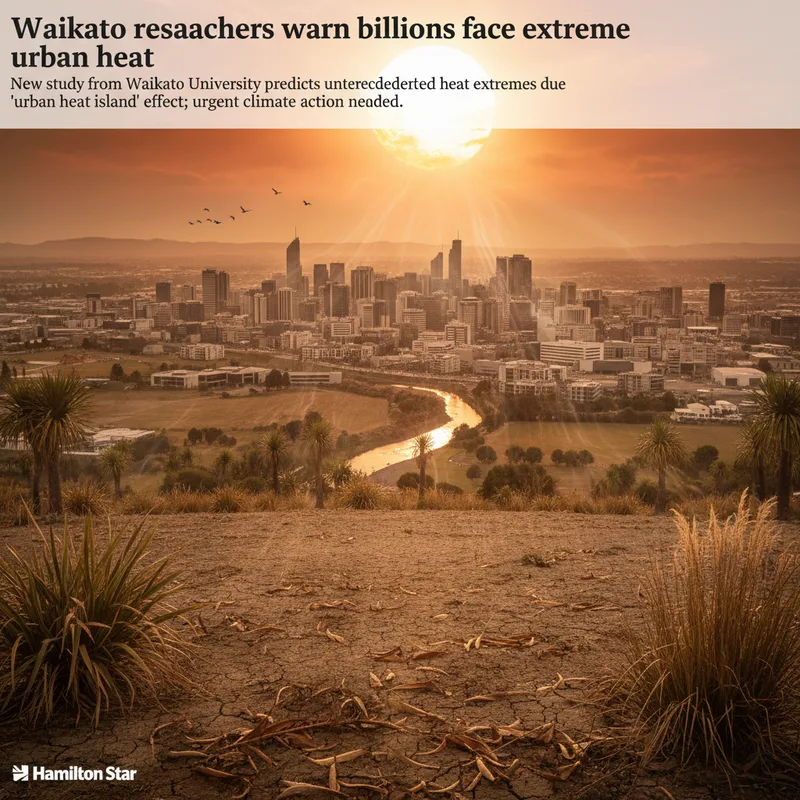
Billions of people living in cities across the globe, including Hamilton, could be exposed to unprecedented and dangerous heat extremes if urgent action isn't taken to curb climate change, a new Waikato University study warns.
The Marsden Fund-backed research, conducted by climate scientists Dr Hamish Lewis and Luke Harrington of the university's Environmental Research Institute, highlights the growing threat of the “urban heat island” effect, a phenomenon already creating hotspots in Hamilton where temperatures can be up to 5°C warmer than surrounding areas.
Dr Lewis said the study focused specifically on cities because of the way urban materials amplify heat. Surfaces like roads, concrete, and buildings absorb and retain solar radiation, effectively "cooking the city from the bottom," he explained. This localised heating, combined with rising global temperatures, creates a dangerous recipe for severe heatwaves.
The researchers modelled two potential futures. One, based on "very ambitious" emissions reduction work, still results in an average global temperature rise of 1.9°C. This scenario would expose approximately one billion urban residents to heat events beyond anything experienced today. The second, a "status quo" scenario where emissions continue on their current trajectory, leads to a devastating 3.1°C rise, subjecting an estimated four billion people to extreme heat.
A future of frequent heatwaves
The study warns that as temperatures rise, heatwaves that were once considered unlikely in a person's lifetime could become a regular occurrence, happening as frequently as every decade. Dr Lewis said that while the effects would be global, the first unprecedented extremes are expected to hit densely populated cities in Southeast Asia.
On a human level, the consequences are stark. More frequent and intense heatwaves disproportionately affect the most vulnerable members of society, including the young and the elderly. The increased heat stress exacerbates existing health problems and is linked to higher mortality rates.
Hamilton, a city known for its hot summers and oceanic climate, has already had a taste of this phenomenon. The city's all-time record temperature stands at 32.9°C, and a 2025 city council report identified hotspots in the central business district and other built-up areas that were significantly warmer than greener parts of the city.
As a key agricultural and economic hub in the North Island, Hamilton's continued growth could exacerbate the heat island effect if new infrastructure and housing developments do not incorporate sustainable, climate-conscious design. The city's expansion underscores the importance of proactive environmental planning, a challenge also reflected in recent calls by Hamilton leaders for more firefighters for the growing city.

Political debate heats up over climate action
Dr Lewis says the alarming future outlined in the study is "all avoidable" if governments take decisive action. He stressed the critical role of policy in driving the large-scale change needed to avert the worst outcomes.
Realistically, it’s those who make policy.. who are able to enact the largest emissions reductions. In response to the growing urgency, Climate Change Minister Simon Watts said the government is committed to New Zealand’s obligations under the State government invests record $2.7b to secure water future, which aims to limit global warming to well below 2°C. He stated that the country is on track to meet its net zero target by 2050, potentially as early as 2044.
"Last quarter emissions were the lowest recorded since the time series started in 2010," Mr Watts said in a statement. "This was driven by our abundant, renewable energy." He highlighted a "technology-led" approach to reducing agricultural emissions, changes to the Resource Management Act to support a "renewable energy boom", and co-investment in the public electric vehicle charging network.
Accusations of
fiscal recklessness' and policy rollbacks
Mr Watts also criticised the previous Labour government, stating "it is a bit rich for Labour to talk about slowing economic activity when it was their fiscal recklessness that saw interest rates skyrocket, leaving National to clean up the mess they left behind.”
However, Labour's climate spokesperson, Deborah Russell, refuted the government's claims of progress, arguing that their actions would ultimately cost the country more in the long run. She pointed to a series of policy changes she says have undermined New Zealand's climate goals.
"It has cancelled the clean car discount, weakened emissions standards for imported vehicles, cut subsidies for public transport, taken the money from the Emissions Trading Scheme and used it for tax cuts instead of investing in clean technologies," Ms Russell said. She added that the government also "refused to sign up to the Roadmap for Transitioning Away from Fossil Fuels at COP 30.”
The debate over climate policy comes as the city's new Youth Council convenes to help shape Hamilton's future, a future that will inevitably be defined by the environmental choices made today. The researchers' findings place a sharp focus on the long-term consequences of current political and developmental decisions, not just for Hamilton but for billions of people worldwide. As Dr Lewis noted, any reduction in temperature, no matter how small it seems, is critically important given the immense scale of the potential impact.