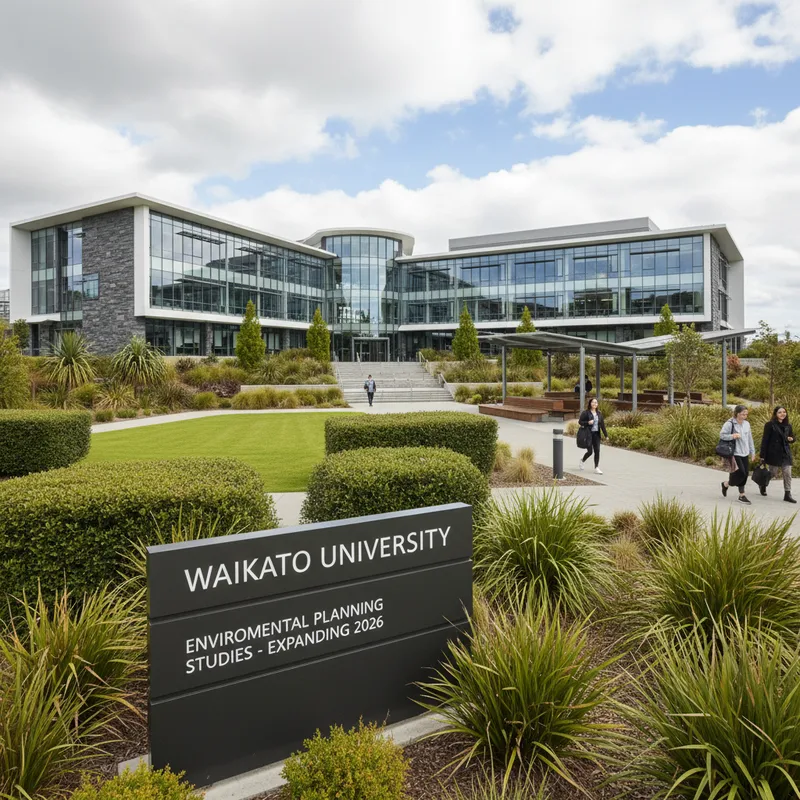
The University of Waikato has announced its updated and extensive curriculum for Environmental Planning for the 2026 academic year, offering a range of undergraduate and postgraduate qualifications designed to equip students with the skills to manage mounting environmental pressures.
The interdisciplinary programme integrates environmental, cultural, social, and economic dimensions to address complex issues. It aims to produce graduates capable of navigating challenges such as urban growth, climate change, and resource management in Aotearoa New Zealand and beyond.
Environmental Planning is available as a dedicated four-year Bachelor of Environmental Planning (BEP) degree, and also as a major within the Bachelor of Arts, Bachelor of Climate Change, and Bachelor of Social Sciences. Students in other undergraduate degrees can also take it as a second major or a minor, pending divisional approval.
The university describes the subject as providing the necessary knowledge and skills for the sustainable management of the environment. This involves a holistic approach, gaining insights into environmental problems to help manage natural and urban resources more effectively. With cities like Hamilton experiencing rapid growth, the principles taught in these courses are becoming increasingly critical for local and national infrastructure planning. Indeed, Auckland and Hamilton will host free international business and tech conferences, highlighting the region's focus on development and innovation.
Specialised streams for BEP students
A cornerstone of the Bachelor of Environmental Planning is its three distinct streams, allowing students to specialise in an area of interest from their first year. The compulsory papers for all BEP students include foundational studies in environmental planning, Māori language and culture, geography, and law, ensuring a broad and robust base of knowledge.
The 'Science and the Environment' stream focuses on the physical and natural sciences. Students in this stream will take papers in subjects like ecology, biodiversity, and earth sciences. Coursework delves into topics from population ecology to interpreting the geological processes that shape the land. This pathway is designed for students passionate about the scientific underpinnings of environmental systems and how to apply that knowledge to planning contexts.
The 'Society and the Environment' stream examines the human dimensions of environmental issues. It incorporates papers from economics, political science, sociology, and population studies. Students explore how policy, social structures, and economic behaviour drive environmental outcomes. This stream prepares graduates for roles in policy analysis, community development, and social impact assessment, addressing issues like the societal effects of extreme urban heat.
Finally, the 'Te Ara Taiao: Māori and the Environment' stream offers a unique pathway centred on Māori worldviews and knowledge systems. Students take a deep dive into te reo Māori, Māori cultural concepts, and their application to environmental management. This stream is vital for developing culturally competent planners who can effectively partner with iwi and hapū, reflecting the principles of Te Tiriti o Waitangi in their professional practice.
Postgraduate and upskilling options
Recognising the need for continuous professional development and career transitioning, the university offers a wide array of postgraduate options. For those with an undergraduate degree in another field like law or science, the Graduate Certificate and Graduate Diploma in Environmental Planning provide a pathway to upskill and gain a recognised qualification in the field.
For advanced study, a suite of postgraduate qualifications is available, including the Postgraduate Certificate, Postgraduate Diploma, and a Bachelor of Social Sciences with Honours in Environmental Planning. These programmes allow students to undertake specialised 500-level papers on advanced topics.
The university also offers the Master of Environmental Planning (MEP), with updated requirements taking effect from 1 July 2024 for all new applicants. The structure of the 120-point or 180-point Master's degree varies based on the candidate's prior qualifications, ensuring a tailored and rigorous programme of study. For those committed to research, a Doctor of Philosophy (PhD) programme is available, culminating in a thesis that makes a substantial and original contribution to the field.
Foundational and interdisciplinary studies
The curriculum's strength lies in its interdisciplinary approach, drawing on a wide range of subjects. Introductory papers like ENVPL100 'Introduction to Environmental Planning' examine the major environmental issues facing Aotearoa, while ENVPL101 'Future Cities' tackles the pressures of population growth, natural hazards, and climate change on urban areas.
These core papers are supplemented by a diverse selection from other departments, including 'Rights and Reasons' (ARTSC103), 'Introduction to Ecology and Biodiversity' (BIOEB102), and 'Economics for Business and Management' (ECONS101). Students are required to take 'He Hīnātore ki te Ao Māori: Introducing the Māori World' (MAORI102), underscoring the university's commitment to a bicultural curriculum.
This integrated structure ensures graduates are not only specialists in planning but also well-rounded thinkers who can collaborate across disciplines. The skills are essential for addressing multifaceted challenges, from planning for natural disasters, as seen in local council emergency strategies, to ensuring infrastructure keeps pace with a growing population. The skills align with the professional standards set by bodies like the New Zealand Planning Institute, the professional body for planners in the country.
Most papers are offered at the university's Hamilton campus, with several also available in Tauranga or online, offering flexibility for students across the country. For specific programme advice, prospective students are encouraged to contact the Division of Arts, Law, Psychology and Social Sciences Office at the university.