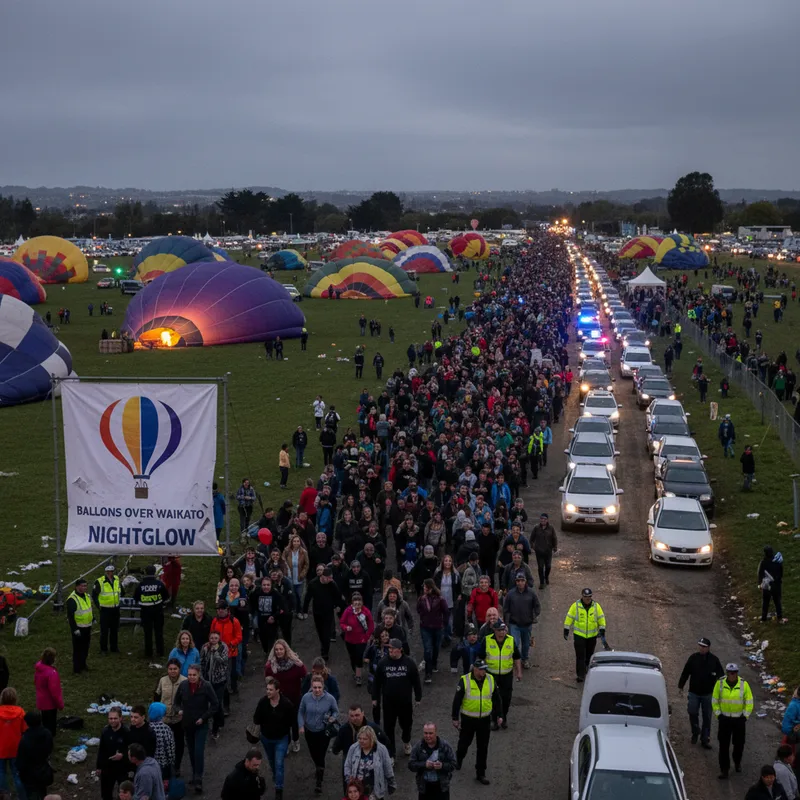
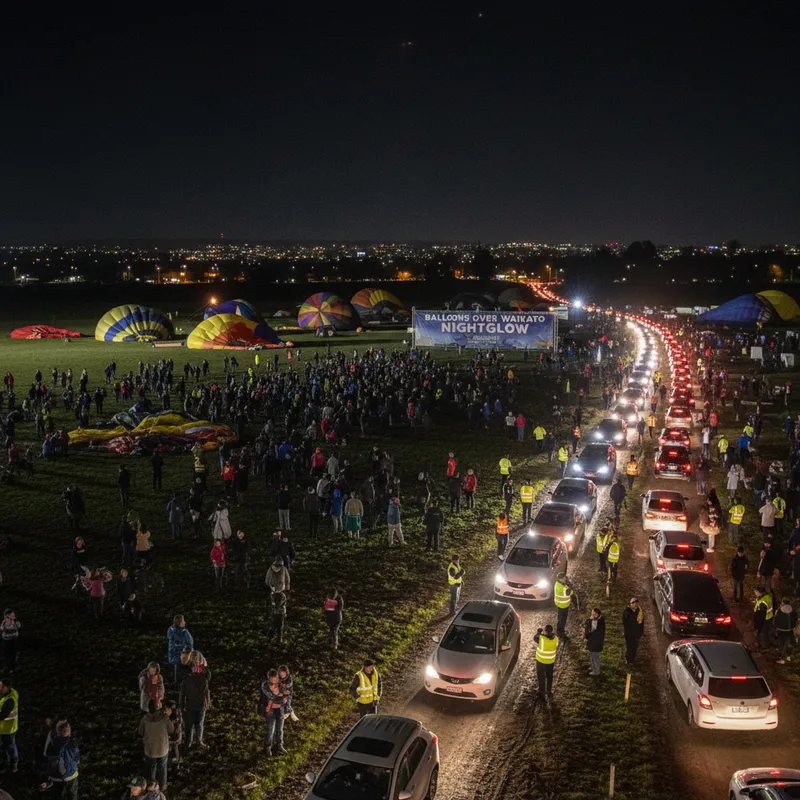
Organisers of the Balloons Over Waikato festival have apologised after its flagship Nightglow event descended into chaos, with thousands of attendees describing 'shocking and unsafe' conditions, dangerous crowding for buses, and gridlocked traffic for hours.
The popular annual event, which attracted more than 55,000 people, was held on Saturday night at the University of Waikato grounds. For the first time, the Nightglow served as the festival's opening event rather than its finale. While many families enjoyed the entertainment and the spectacle of the glowing hot air balloons, the evening soured for many as soon as the show ended around 8.30pm.
Social media was flooded with complaints from distressed attendees. The most serious concerns centred on the free bus services, with reports of 'crushing' in queues that spilled onto roads. One father described grown adults pushing people onto overflowing buses, causing children and the elderly to be crushed. He wrote that children were 'crying and screaming from the panic', adding that one child was separated from their mother when a bus door closed.
Another attendee said it 'felt like there wasn’t any crowd management or safety plans'. Many reported waiting up to two hours to board a bus, with waits continuing past 10pm. Hato Hone St John confirmed it attended a fall incident on the periphery of the event at 8.42pm and transported one patient to Waikato Hospital in a moderate condition.
Event 'didn’t seem organised at all'
Beyond the bus services, attendees faced a 'nightmare' of traffic congestion and parking failures. Drivers reported being stuck in exiting traffic for as long as two hours, with little to no direction from traffic management personnel. 'Exits not being utilised, no one directing traffic efficiently,' one person commented online.
Frustration was compounded for those who had pre-paid for parking, only to be turned away upon arrival because the designated areas were already full. Organisers later explained this was due to vehicles parking in the spaces before event operations were fully in place.
On-site experiences were also criticised. Some attendees situated towards the back of the main stage area reported poor sound quality, stating they 'could hear was the bass' and that the music and speaking were inaudible. Others noted that several of the hot air balloons were illuminated for only a few minutes before being deflated.
Balloons Over Waikato, the trust that owns the festival, contracted Wellington-based company Lightning Events to deliver the event. In a statement, the organisers acknowledged that the experience 'did not meet expectations'.
Organisers take responsibility for failures
Responding to the widespread backlash, Balloons Over Waikato chairman Steve Gow apologised on behalf of the event, acknowledging the frustration felt by the community.
We’re sorry to those who experienced delays or disruption. That’s not the experience we want for our community, and we take responsibility for that.
Mr Gow said that while detailed plans for transport and parking were in place, 'the delivery on the night did not operate as planned, which contributed to congestion and confusion'. He stated that the four operational exit points had capacity exceeding New Zealand requirements for an event of its size, and that the site was cleared within an 'expected' timeframe of one hour and 40 minutes.
He confirmed that anyone who pre-paid for parking and was unable to find a spot would receive a full refund and should contact the organisers directly.
Transport partnership under review
The chaotic scenes have put the event's transport arrangements under intense scrutiny. The free park-and-ride bus service was a partnership between the festival and Waikato Regional Council, which coordinated the service through its providers.
A spokesperson for the council acknowledged the 'delays experienced on the night, which will have been frustrating for some bus passengers'. The council is now working with the event organisers and transport providers to identify what went wrong and where improvements can be made, noting it was the 'first event under new arrangements at the University of Waikato'.
The issues highlight the significant logistical challenges of staging large-scale public events in Hamilton. Efficient public transport is critical to managing traffic and ensuring public safety, a key focus of the council's regional transport planning. The failure to manage the exodus of 55,000 people raises questions about the planning and resources allocated to the event's transport strategy. As Hamilton's population grows, so does the strain on its infrastructure, a challenge seen in recent debates over projects like water metering.
The Nightglow's return to the university grounds, after three years at Claudelands Oval, was initially welcomed by many. The university campus offers a sprawling, picturesque setting, but its road network and access points proved challenging for an event of this magnitude. For comparison, other cities are actively investing in transport infrastructure to support large gatherings and daily commutes, such as when Auckland opened two major new cycling and walking paths to ease congestion.
As the festival continues with its morning flights over the city, which began with the popular first ascents over Hamilton Lake, the organising trust faces pressure to ensure no repeat of Saturday's chaos. For information on regional bus services, residents can consult the Waikato Regional Council's public transport website.
Mr Gow has stated that the organisers are committed to learning from the failures. 'We know how important this event is to our community and we are committed to improving the experience,' he said.