Nearly four years after they vanished from Te Kūiti, the discovery of Heath's body just 20 kilometres from home raises painful questions about search efforts for vulnerable missing persons
Discovery ends four-year search
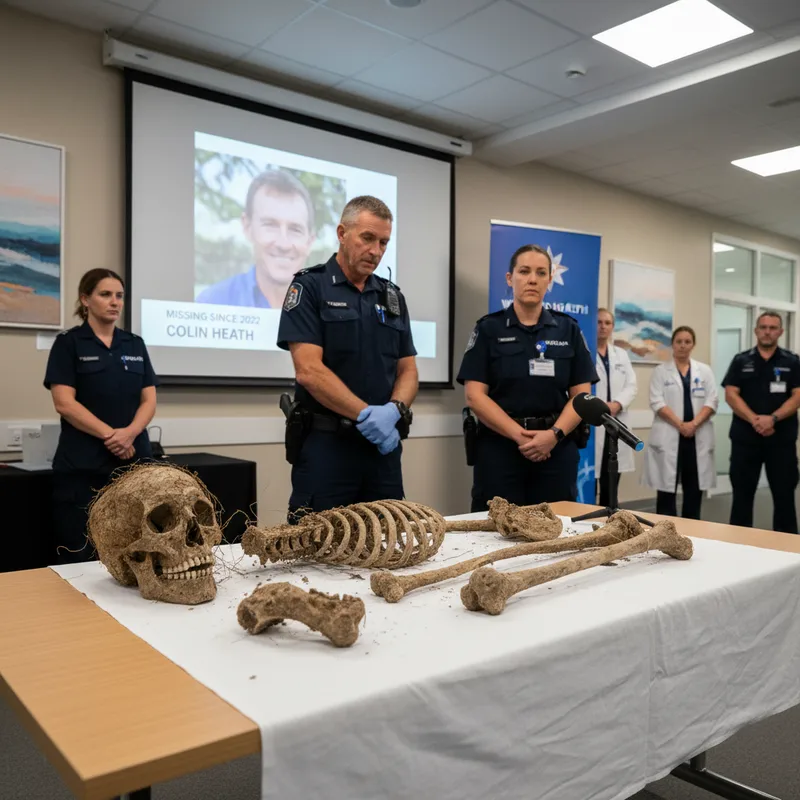
Clare Douglas was leading a group of about six weed controllers cutting privet near State Highway 3 between Ōtorohanga and Te Awamutu when the others called out that they'd found a body. "The group was all huddled together, and I went over and said 'get back to work', and saw the body lying there ... took me a couple of minutes to realise what it was and what we should do, and so yeah, I called the police," she said. "It didn't feel real to me, and even now it feels surreal, I've been in shock all day."
The skeleton, still clothed and wearing work boots, lay in overgrown bush that Douglas said had been untrimmed for decades. "At least there'll be some closure hopefully for a family, finding their loved one, hopefully," she said.
Police have now identified the remains as Colin (Col) Heath, whose pronouns were they/them. Heath was 46 when reported missing on March 19, 2022, after being last seen in Te Kūiti.
For friends who had searched tirelessly for nearly four years, the discovery brought a devastating mix of relief and anger.
Archie Bailey, a close friend, told the Herald it all added up immediately. "I knew where their cellphone had last pinged – which was just out of Ōtorohanga. As soon as we saw that location, we were like 's*'!"
Bailey's frustration was palpable: "My question for police is did they search that area or not? And if not, why not? Because their body was found in what we believe is the middle of the cellular corridor for the last cell tower Col's phone pinged from."
A life on society's margins
Colin Heath went missing when living in Te Kūiti. Heath was 46 and last seen by a flatmate in the town on March 19 in 2022. Heath identified as non-binary and went by the pronouns they/them. They had only moved to the North Island from Dunedin months before their disappearance.
Those who knew Heath paint a portrait of someone deeply passionate but struggling with their place in the world.
One friend described them as "a beautiful oddball" — "Quiet but fierce. Very, very passionate about the things that they cared about. Loved a good protest. Whatever protest there'd be, nine times out of ten you'd see Col, be able to sign with a made-up sharpie. Didn't necessarily matter what the protest was for. Col would be there just having a good time."
But beneath the activist exterior was someone in pain: "Really gentle. And loving. Had so much love to give, but didn't. The world didn't always love Col the way that it should have. Col had a harder life than most. And it had, you know, a fair amount of mental health struggles, troubles and things like that going on."
Bailey believes Heath was experiencing mental distress when they disappeared. "Our assumption was that Col was experiencing mental distress, and our belief was that they would have walked deep into the bush and taken their own life," Bailey said. "So based on that obvious scenario, most of us came to terms with the idea that Col's body would never be found."
Questions about the search
In 2022, police issued an appeal for information the following month on the Waikato police Facebook page, followed by media reports in August, a fresh police appeal in September and a televised plea for information by family on Police Ten 7 in December.
Heath's bank accounts had not been touched since their disappearance and telecommunications efforts were unsuccessful. Police said Heath's family were "extremely concerned for his wellbeing given the length of time that has passed since he disappeared."
Yet despite these efforts, Heath's body lay undiscovered beside a major highway for nearly four years — a fact that has left friends questioning whether enough was done.
One friend was blunt in their assessment: "The thing I would really like to say is that just because someone is an oddball, who might not fit neatly in a box or kind of more the fringes of society, doesn't mean they're not valued as a person and doesn't mean that they aren't loved and shouldn't be looked for... just because Col, you know, had mental health struggles and was queer and was kind of anti-establishment and loved a good protest and ... all the things that Col was doesn't mean that they weren't a loved human being - that didn't deserve to be looked for. If Col was not Col, there would have been a lot more media attention and more police resources allocated to try and find them."
It was particularly hard to accept that Heath was found less than 20 kilometres from their home.
The location — in bush visible from State Highway 3 — has raised uncomfortable questions about the thoroughness of the initial search efforts.
Bailey, who described themselves as Heath's "chosen sibling", said the location of the discovery was especially painful: "It is particularly painful, given that this person struggled deeply with their own sense of worth in the world."
Pattern of tragedy
Heath's case sits within a troubling pattern in the Waikato region.
In January, while searching the Waikato River for 25-year-old Teananga Tiotia who was reported missing after being swept downstream near Graham Island, police also found the body of 39-year-old Aydan Brown inside a vehicle. Brown had been missing from Hamilton's Chartwell suburb since August 2025.
According to police records, another person, also named Aydan Brown, has been missing from Hamilton since 17 August 2025.
The Waikato River, which runs through the heart of Hamilton, has been the site of multiple tragedies involving missing persons.
These cases highlight the challenges facing search and rescue efforts in the region, where dense bush, waterways, and vast rural areas can make locating missing persons extremely difficult — especially when resources are limited and search areas are unclear.
Moving forward
Police confirmed Heath's identity in a statement, extending "sympathies to Col's family, who have asked for privacy at this difficult time." Heath's death has been referred to the Coroner.
For those who searched for Heath, the discovery brings no real satisfaction — only questions about what might have been different.
Bailey remembered their friend as "Deeply passionate about how to create change in the world at a really high level. A deep thinker and somebody who was worth a hell of a lot more than they thought they were."
The tragedy has sparked renewed calls for better support and search protocols for vulnerable missing persons, particularly those from marginalised communities who may not receive the same level of attention or resources. In a region where missing persons cases continue to mount, Heath's story serves as both a cautionary tale and a call to action.
As one friend put it simply:
"Col was just a beautiful, beautiful human who deserved a lot better in life and a heck of a lot better in death."